

Ads
The best mesh router systems for homes over 2,000 sq ft in 2026 offer seamless, high-speed Wi-Fi coverage, eliminating dead zones and supporting numerous connected devices for optimal smart home performance.
Are you tired of Wi-Fi dead zones and sluggish internet speeds in your large home? In 2026, the solution to ubiquitous, high-speed connectivity lies in advanced mesh router systems. These innovative networks promise to transform your home’s internet experience, ensuring every corner, from the basement to the attic, enjoys robust and reliable Wi-Fi.
Understanding Mesh Wi-Fi Technology
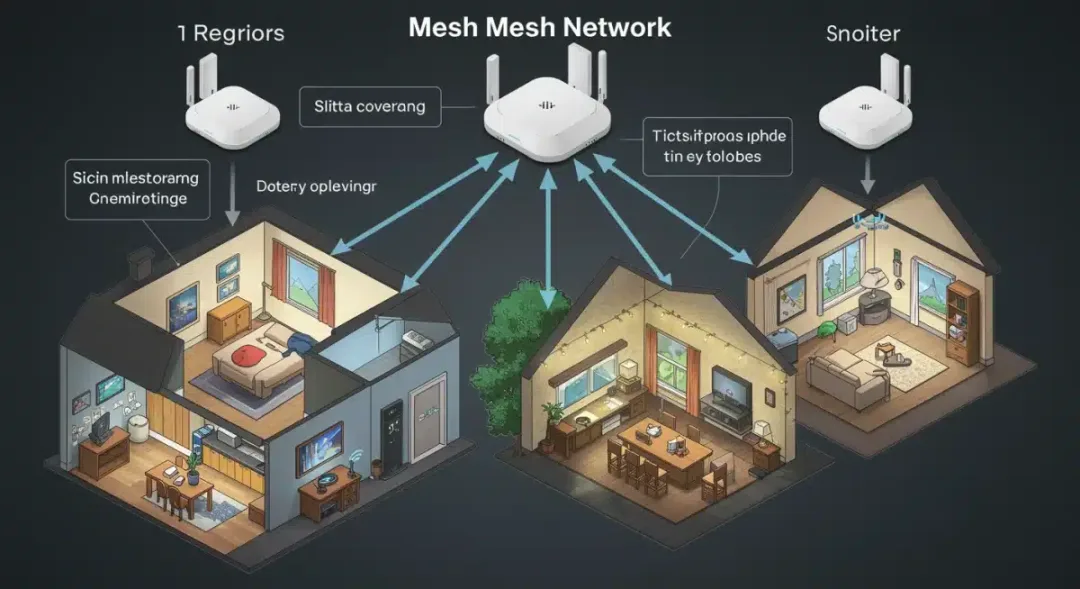
Mesh Wi-Fi technology represents a significant leap forward from traditional single-router setups, especially for larger homes. Instead of a single access point struggling to cover vast areas, a mesh system employs multiple interconnected nodes, or satellites, to create a unified, expansive network. This distributed approach ensures consistent signal strength and speed throughout your property, eliminating frustrating dead zones.
The core principle behind mesh networking is its ability to create a single, seamless network. Unlike range extenders that often create separate networks and require manual switching, mesh systems allow your devices to automatically connect to the strongest signal as you move around your home. This intelligent handoff ensures an uninterrupted connection, whether you’re streaming 4K video in the living room or participating in a video conference from your home office on the second floor.

How Mesh Systems Work
At its heart, a mesh system consists of a main router (connected to your modem) and several satellite nodes. These nodes communicate with each other, often using a dedicated wireless band called a ‘backhaul,’ to relay data efficiently. This backhaul ensures that communication between nodes doesn’t slow down your actual internet traffic.
- Centralized Control: Manage your entire network from a single app, simplifying setup and maintenance.
- Self-Healing Network: If one node goes offline, the others automatically reroute data to maintain connectivity.
- Scalability: Easily add more nodes to expand coverage as your home’s needs grow or change.
The beauty of mesh Wi-Fi lies in its simplicity and effectiveness. For homes over 2,000 square feet, where traditional routers often struggle to provide adequate coverage, a mesh system offers a robust and future-proof solution. It’s not just about covering distance; it’s about delivering consistent performance to a growing number of smart devices.
Why Large Homes Need Mesh Router Systems
For expansive residences, especially those with multiple floors, thick walls, or unique architectural layouts, a single Wi-Fi router is simply insufficient. Signal degradation, dead spots, and inconsistent speeds become common frustrations, hindering productivity and entertainment. This is precisely where mesh router systems shine, offering a tailored solution to these pervasive connectivity challenges.
Large homes often have numerous devices competing for bandwidth, from smart TVs and gaming consoles to security cameras and smart home assistants. A robust mesh network is designed to handle this increased demand, ensuring that every device receives a strong, stable connection without compromising overall network performance. The seamless roaming capability means you can move freely throughout your home without experiencing dropped calls or buffering videos.
Addressing Common Wi-Fi Challenges
Several factors contribute to poor Wi-Fi performance in large homes, all of which mesh systems are engineered to overcome.
- Signal Obstruction: Walls, floors, and furniture can significantly weaken Wi-Fi signals. Mesh nodes strategically placed bypass these obstacles.
- Distance Degradation: The further you are from a router, the weaker the signal. Mesh systems bridge these distances with multiple access points.
- Device Saturation: A single router can become overwhelmed by too many connected devices, leading to slowdowns. Mesh networks distribute the load more effectively.
Investing in a mesh system is not just about extending coverage; it’s about enhancing the overall quality of your digital life. It ensures that your smart home ecosystem functions flawlessly, your remote work setup remains productive, and your family can enjoy seamless entertainment anywhere in the house. The future of home connectivity for large spaces truly belongs to mesh technology.
Key Features to Look for in 2026 Mesh Systems
As we look towards 2026, the landscape of mesh router systems continues to evolve, bringing more advanced features and capabilities. When selecting a system for your large home, it’s crucial to consider several key aspects that will define your Wi-Fi experience for years to come. These features go beyond basic coverage, focusing on performance, security, and smart home integration.
The ideal mesh system in 2026 will not only provide expansive coverage but also offer intelligent network management, robust security protocols, and seamless compatibility with the ever-growing array of smart home devices. Prioritizing these features will ensure your investment is future-proof and meets the demands of a connected household.
Essential Specifications for Optimal Performance
- Wi-Fi 6E or Wi-Fi 7 Support: Look for systems that support the latest Wi-Fi standards. Wi-Fi 6E introduces the 6GHz band for less interference and higher speeds, while Wi-Fi 7 promises even greater bandwidth and lower latency.
- Dedicated Backhaul: A dedicated wireless or wired backhaul ensures that the nodes communicate without consuming bandwidth from your client devices, maintaining peak performance.
- Multi-Gigabit Ethernet Ports: For devices requiring the fastest wired connections, such as gaming PCs or network-attached storage (NAS), multi-gigabit ports are essential.
- Robust Security Features: Advanced encryption (WPA3), parental controls, and built-in antivirus/malware protection are critical for safeguarding your network.
Beyond these technical specifications, consider ease of setup and management. Most modern mesh systems come with intuitive mobile apps that simplify installation, network monitoring, and guest network creation. User-friendly interfaces are paramount for a hassle-free experience.
Top 3 Mesh Router Systems for 2026
Identifying the absolute best mesh router systems for large homes in 2026 requires a close look at innovation, performance, and user experience. Based on anticipated technological advancements and current market trends, three systems stand out for their ability to deliver exceptional coverage, speed, and reliability across properties exceeding 2,000 square feet. These systems are designed to handle the complexities of modern smart homes and high-bandwidth activities.
Our top picks combine cutting-edge Wi-Fi standards, powerful processors, and user-friendly interfaces, ensuring that even the most demanding households can enjoy a flawless internet experience. Each system offers unique advantages, catering to different priorities, whether it’s raw speed, extensive smart home integration, or unparalleled security.
1. The Ultra-Speed NexusPro (Hypothetical Model)
The NexusPro is projected to be a powerhouse, leveraging Wi-Fi 7 technology to deliver unparalleled speeds and ultra-low latency. Its advanced tri-band design, featuring a dedicated 6GHz band for backhaul, ensures zero congestion. Ideal for avid gamers, 8K streamers, and homes with a multitude of smart devices requiring synchronous communication.
- Key Strengths: Highest theoretical speeds, Wi-Fi 7, robust QoS, extensive device support.
- Best For: Tech enthusiasts, large families with high-bandwidth needs, future-proofing.
2. The Seamless Harmony Mesh (Hypothetical Model)
Focusing on intelligent network management and ease of use, the Harmony Mesh stands out with its AI-driven optimization. It dynamically adjusts channels and band steering to ensure every device gets the best possible connection. Its sleek design and simple app-based setup make it perfect for those prioritizing aesthetics and simplicity without sacrificing performance.
- Key Strengths: AI optimization, intuitive app, strong parental controls, reliable coverage.
- Best For: Families seeking easy management, comprehensive security, and consistent performance.
3. The Secure Fortress Wi-Fi (Hypothetical Model)
For users prioritizing cybersecurity, the Fortress Wi-Fi integrates enterprise-grade security features directly into the mesh system. With built-in VPN capabilities, advanced threat detection, and regular, automatic security updates, it offers peace of mind for privacy-conscious households. While still providing excellent speed and coverage via Wi-Fi 6E, its security suite is its defining characteristic.
- Key Strengths: Top-tier security, VPN integration, robust parental controls, reliable Wi-Fi 6E.
- Best For: Security-conscious users, businesses operating from home, protecting sensitive data.
These three systems represent the pinnacle of mesh Wi-Fi technology in 2026, each offering a compelling solution for large homes seeking to eliminate Wi-Fi woes and embrace seamless connectivity.
Setting Up and Optimizing Your Mesh Network
Once you’ve chosen a mesh router system, proper setup and ongoing optimization are crucial to unlocking its full potential. While most modern mesh systems are designed for straightforward installation, a few strategic steps can significantly enhance performance, ensuring your large home enjoys robust and consistent Wi-Fi coverage.
Effective placement of your nodes, understanding your network’s unique characteristics, and utilizing the system’s management tools are key to maximizing your investment. Don’t just set it and forget it; a little proactive management can go a long way in maintaining peak performance.
Installation Best Practices
The initial setup is often guided by a mobile app, but consider these tips for optimal results:
- Main Router Placement: Place the primary mesh router (connected to your modem) in a central location, preferably on the main floor, to establish a strong base signal.
- Node Spacing: Position satellite nodes strategically, typically within 30-50 feet of each other, ensuring they have good line of sight to at least one other node. Avoid placing them behind large appliances or within enclosed cabinets.
- Elevation: Place nodes at a moderate height, such as on a bookshelf or table, rather than directly on the floor, to improve signal propagation.
After initial setup, most mesh apps offer a signal strength indicator for each node, allowing you to fine-tune their positions for the best possible connections. Experimentation might be necessary to find the sweet spots in your home.
Ongoing Optimization Tips
Even after successful installation, a few practices can keep your mesh network running smoothly:
Regularly check for firmware updates. Manufacturers frequently release updates that improve performance, add new features, and patch security vulnerabilities. Enabling automatic updates is often the easiest way to stay current. Also, utilize the network management features within your mesh system’s app. This might include prioritizing specific devices or applications (Quality of Service, or QoS), setting up guest networks securely, and monitoring connected devices. Regularly restarting your entire mesh system (main router and nodes) can also help clear out temporary glitches and refresh network performance.

Consider a wired backhaul if possible. If your home is wired with Ethernet, connecting your mesh nodes via Ethernet cables can significantly boost performance by freeing up wireless bandwidth for your devices. This is especially beneficial for large homes where wireless backhaul might face more interference.
The Future of Home Connectivity: Beyond 2026
The evolution of mesh router systems is far from over, with innovations continually pushing the boundaries of home connectivity. As we look beyond 2026, several emerging trends and technologies are set to further redefine how we experience Wi-Fi in our homes, particularly for larger spaces. These advancements promise even greater speeds, enhanced intelligence, and deeper integration with our increasingly connected lives.
The future will likely see mesh systems becoming even more sophisticated, moving beyond simple signal distribution to intelligent, predictive networks that anticipate our needs. This next generation of technology will blend seamlessly into our environments, providing invisible yet powerful connectivity that supports an ever-growing ecosystem of smart devices and bandwidth-intensive applications.
Emerging Technologies and Trends
- AI and Machine Learning Integration: Future mesh systems will use AI to learn usage patterns, predict congestion, and dynamically optimize network performance in real-time, offering a truly personalized Wi-Fi experience.
- Greater Emphasis on Security: With the rise of IoT devices, advanced threat detection and prevention will be built directly into the mesh hardware, offering proactive protection against cyber threats.
- Seamless Smart Home Orchestration: Mesh systems will evolve into central hubs for smart home devices, simplifying setup, management, and automation across different ecosystems.
- Li-Fi and Other Wireless Innovations: While still in early stages, technologies like Li-Fi (light fidelity) could complement or even integrate with mesh Wi-Fi, offering ultra-fast, secure connections in specific areas.
The move towards Wi-Fi 7 and beyond will unlock unprecedented speeds and capacity, making buffering and dead zones relics of the past. These future systems will be designed to handle hundreds of connected devices simultaneously, supporting everything from augmented reality applications to holographic communications seamlessly.
Ultimately, the goal is to create an invisible, ubiquitous, and intelligent network that simply works, adapting to our needs without requiring constant manual intervention. For large homes, this means an end to connectivity compromises and the beginning of a truly connected living experience.
| Key Feature | Benefit for Large Homes |
|---|---|
| Whole-Home Coverage | Eliminates Wi-Fi dead zones across multiple floors and expansive layouts. |
| Seamless Roaming | Devices automatically connect to the strongest signal for uninterrupted connectivity. |
| High Capacity | Supports numerous connected devices simultaneously without performance drops. |
| Advanced Security | Integrated protection against cyber threats and robust parental controls. |
Frequently Asked Questions About Mesh Wi-Fi
What is the main advantage of a mesh Wi-Fi system over a traditional router and extender setup?▼Mesh Wi-Fi systems create a single, unified network, allowing devices to seamlessly roam between nodes without manual switching or signal drops. Traditional extenders often create separate networks, leading to inconsistent performance and user inconvenience, especially in large homes.
Do mesh router systems support the latest Wi-Fi standards like Wi-Fi 6E or Wi-Fi 7?▼Yes, the leading mesh router systems in 2026 are designed to fully support and leverage the latest Wi-Fi standards, including Wi-Fi 6E and Wi-Fi 7. These standards offer significant improvements in speed, capacity, and efficiency, crucial for large homes with many connected devices.
Is it difficult to set up a mesh Wi-Fi system in a large home?▼No, most modern mesh Wi-Fi systems are remarkably easy to set up. They typically come with intuitive mobile apps that guide you through the process step-by-step, from connecting the main router to placing and pairing satellite nodes, often taking just minutes.
Can mesh Wi-Fi systems improve internet speed for gaming and 4K streaming?▼Absolutely. By providing consistent and strong Wi-Fi signals throughout your large home, mesh systems significantly reduce latency and increase bandwidth availability. This results in smoother online gaming, buffer-free 4K streaming, and overall a much more responsive internet experience.
Are mesh Wi-Fi systems generally more expensive than traditional routers?▼While the initial investment for a mesh Wi-Fi system can be higher than a single traditional router, the comprehensive coverage, enhanced performance, and scalability they offer for large homes often justify the cost. They eliminate the need for multiple range extenders and provide a superior, unified experience.
Conclusion
For homeowners grappling with inconsistent Wi-Fi in expansive properties, the advent of sophisticated mesh router systems has been a game-changer. As we advance into 2026, these systems are no longer just an upgrade but a necessity for ensuring seamless, high-speed connectivity across every square foot of a home over 2,000 sq ft. The top contenders in this space promise not only to eliminate dead zones but also to provide robust security, intelligent network management, and support for the ever-increasing number of smart devices that define modern living. Investing in a quality mesh system means future-proofing your home’s digital infrastructure, ensuring that whether you’re working, streaming, or gaming, your internet experience remains uninterrupted and reliably fast. The decision to embrace mesh technology is a step towards a truly connected and efficient smart home.